I am a full professor at the School of Data Science, Fudan University, where I lead the Logos Robotics Group. I also hold a joint appointment at the Shanghai Innovation Institute (SII).
I completed my PhD in computer science at Queen Mary University of London under professor Tao Xiang, and was subsequently a postdoctoral researcher in the Department of Engineering Science at the University of Oxford with professor Philip H.S. Torr and professor Andrew Zisserman, followed by a role as Research Scientist at Samsung AI Center Cambridge.
☆ News ☆
Two papers to appear in NeurIPS 2026.
I will be serving as an Area Chair for ICLR 2027.
I will be serving as an Area Chair for CVPR 2027.
One paper to appear in CoRL 2026.
One paper to appear in SIGGRAPH Asia 2026.
Show moreShow less
I will be serving as a Senior Program Committee for AAAI 2027.
The goal of our group is to build intelligence for robotics, which falls under physical AI.
Specific areas of interest include embodied intelligence 🦾, general-purpose multimodal large models 🧠 and agents 🧑💻, and—to a lesser extent—3D vision and autonomous driving 🚗.
Interested in joining the group?
If you are highly creative, have top grades/coding skill and interested in joining my group please do not hesitate to send me your CV and transcripts of grades.
Make sure you are super enthusiastic about AI research.
This paper introduces a shared model for whole-body control across humanoids with different bodies. A common Transformer captures reusable motion structure, while robot-specific modules translate human motion and sparse VR commands into actions suited to each robot.
This paper studies how humanoids can preserve the intent of human motion while respecting their own physical constraints. Physics-based experts provide trajectories for training a causal model that generates robot motion references from streaming human observations.
This paper presents a framework that combines autonomous execution, human corrections, and online policy updates during robot deployment. TIDE distinguishes human demonstrations from the robot’s own experience, allowing both to improve the policy through supervised learning.
This paper studies how humanoids can learn from human corrections that are not always expert demonstrations. Reinforcement learning identifies valuable behaviors in mixed-quality experience, while human videos help the value model recognize failures and recoveries.
This paper introduces an efficient framework for generating detailed 2K textures on 3D assets with multi-view diffusion. It removes background tokens and sparsifies foreground attention, while foreground-aware decoding preserves the fine detail of the generated textures.
This paper uses predictions of an action’s consequences to improve robot policies during training. An asymmetric architecture lets future-state supervision shape action features while keeping future generation out of the deployment-time control loop.
This paper introduces tactile prediction and real-time action correction for contact-rich manipulation. TacPAC compares predicted touch with live tactile feedback and uses the differences to correct upcoming actions without interrupting execution.
This paper learns a transferable dynamics prior by pretraining a world model on diverse robot manipulation data. The same prior supports both long-horizon visual simulation and an instruction-conditioned policy that jointly predicts future observations and robot actions.
This paper bridges the gap between visually plausible imagined futures and executable robot actions. A mixture of inverse dynamics models extracts complementary motion, depth, and semantic cues from predicted visual transitions to guide robot control.
This paper trains navigation policies on the states they visit, using a global planner to supply expert guidance in simulation. This online imitation loop reduces compounding errors and transfers to real-world navigation without additional training.
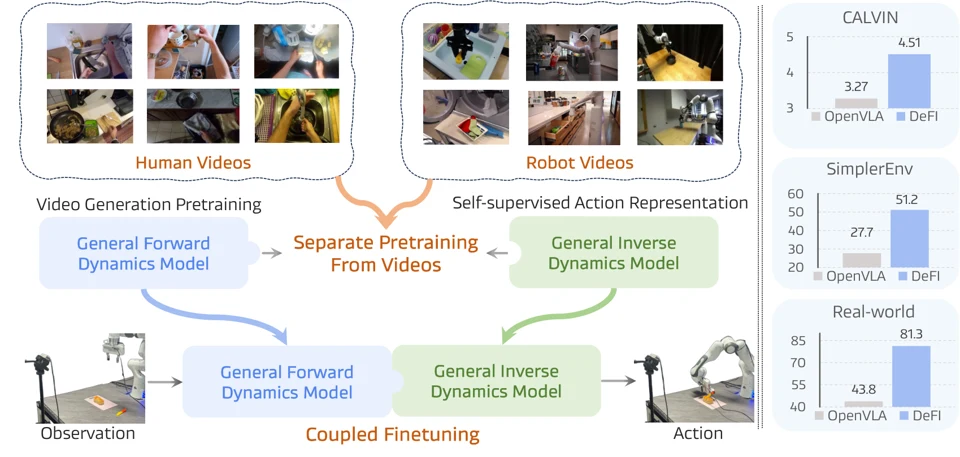
This paper separates future prediction from action inference during pretraining so robots can learn from human and robot videos without action labels. The two models are then combined and jointly fine-tuned for downstream manipulation tasks.
This paper introduces controllable vehicle insertion into driving scenes through video inpainting guided by point clouds. A hierarchical generation strategy maintains each vehicle’s appearance over time, while reconstruction into 3D Gaussians makes the results usable in real-time simulation.
This paper models static structures and moving objects together by extending 3D Gaussian splatting with time-varying, periodic motion. The unified representation reconstructs dynamic urban scenes from sparse observations and supports real-time rendering without manually labeling individual vehicles.
This paper uses a learned action-to-video world model as a simulator for improving robot policies beyond imitation. ProphRL combines this model with reinforcement learning tailored to flow-based action generation, enabling policies to learn more reliable strategies before deployment on real robots.
This paper uses depth and visual history to give robot policies a more consistent understanding of where objects are and how scenes evolve. Coordinate alignment and informative frame selection improve learning across diverse demonstrations.


 under professor
 with professor